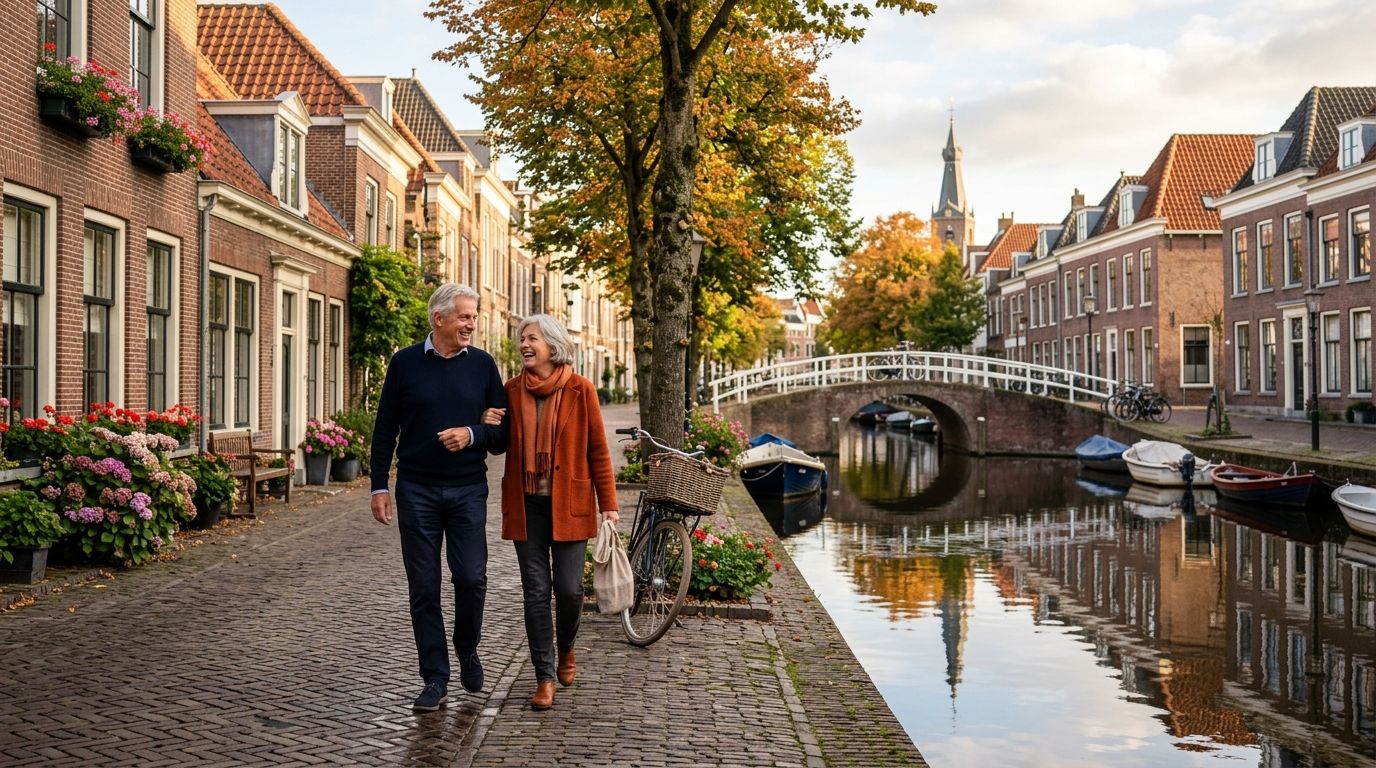
Retiring in the Netherlands in 2026 means picking a place where the daily walk to the pharmacy doesn't involve a hill, the GP practice takes new patients, and the train to the airport runs every 15 minutes for when family visits. This guide ranks six areas against those exact criteria, not against tourist appeal.
- Benoordenhout in The Hague is the best neighborhood for retirees in the Netherlands who want an established international community nearby.
- Amstelveen wins for retirees who want flat, green streets ten minutes from Amsterdam Zuid.
- Haarlem and Leiden suit retirees who want canal-town charm with a direct rail line into a bigger city.
- Maastricht fits retirees who want a slower pace and quick day trips into Belgium and Germany.
- Relocify lets you view a Dutch rental remotely and sign the lease before you fly in.
Why this matters
Most "best places to live in the Netherlands" content is written for 28-year-old software engineers chasing office proximity. Retirees weigh different things: elevator access instead of a fourth-floor walk-up, a GP who isn't fully booked, and a manageable distance to Schiphol for grandchildren flying in. Relocify works through these areas daily for clients relocating without visiting the Netherlands first, and the pattern is consistent — the neighborhoods that work for retirees are rarely the ones dominating expat forums aimed at younger arrivals.
Non-EU retirees also face a housing wrinkle that younger movers don't: without a Dutch employer sponsoring a visa, income verification and health insurance proof become the two gatekeeping documents for both the residence permit and the lease itself. That shapes which landlords and which cities are realistic in 2026, and it's a factor every ranking below accounts for.
What makes the best neighborhood for retirees in the Netherlands
- Healthcare access — walking or short-bike distance to a GP practice with open registration and a hospital within a reasonable transit ride
- Walkability and flat terrain — short blocks, minimal stairs, cycling infrastructure that doesn't require confidence in traffic
- English-language services — banks, GPs, and municipal desks that handle non-Dutch speakers without a translator
- Rail and transit connections — a direct or one-transfer route to Schiphol for family visits and to a major hospital city
- Community and pace — an existing international or retiree population and a noise level below student-district standard
- Housing stock suited to aging in place — ground-floor units, elevators, or single-level layouts, not just walk-up canal houses
At a glance: best areas for retirees in 2026
| Area | Best for | Standout feature | Key limitation |
|---|---|---|---|
| The Hague — Benoordenhout/Statenkwartier | Established international community | Embassy-district calm, English-speaking GPs | Higher demand for ground-floor units |
| Amstelveen | Green, walkable suburb near Amsterdam | Flat streets, large international population | Limited historic character |
| Haarlem | Canal-town feel with city access | Direct 15-minute train to Amsterdam Centraal | Older housing stock, fewer elevators |
| Leiden | Compact cultural city | Small enough to walk everywhere, university-town amenities | Smaller international retiree community |
| Utrecht | Central rail hub | Trains to nearly every Dutch city from one station | Busier, less quiet than suburbs |
| Maastricht | Slower pace, cross-border living | Easy access to Belgium and Germany | Furthest from Schiphol, longer family-visit trips |
1. The Hague (Benoordenhout/Statenkwartier): best for an established international community
The Hague hosts the largest concentration of embassies, international organizations, and long-term expat retirees in the country, and the Benoordenhout and Statenkwartier districts sit at the quiet end of that population. Streets are wide, tree-lined, and largely free of the nightlife noise that hits central Amsterdam. GP practices in this part of the city see enough international patients that English-language appointments are routine rather than exceptional.
The Hague pros:
- Largest existing international retiree and diplomatic community in the Netherlands
- English-speaking healthcare and municipal services are the norm, not the exception
- Direct rail connections to Schiphol and Amsterdam in under an hour
- Coastal air and beach access at Scheveningen, a short tram ride away
The Hague cons:
- Ground-floor and elevator units in Benoordenhout get claimed fast — plan a search window of a few months, not weeks
- Rents in these specific districts sit above the national average for comparable square footage
Best for: retirees who want to plug into an existing English-speaking social network on day one.
Verdict: Buy. If community and English-language services matter more than budget flexibility, this is the strongest fit on the list.
2. Amstelveen: best for flat, walkable streets near Amsterdam
Amstelveen sits just south of Amsterdam and functions as its quieter, greener neighbor — flat terrain, wide sidewalks, and one of the highest concentrations of international residents outside the capital itself. It's a 15-minute tram ride from Amsterdam Zuid, close enough for museums and hospitals, far enough to avoid canal-house stairs and tourist crowds.
Amstelveen pros:
- Flat, low-traffic streets with minimal elevation change — a real factor for mobility as you age
- Large international population with English widely spoken in shops and services
- Direct tram access to Amsterdam Zuid's hospitals and Schiphol
- More modern housing stock with elevators than central Amsterdam offers
Amstelveen cons:
- Lacks the historic canal-house character some retirees picture when they imagine the Netherlands
- Fewer independent cafes and cultural venues than Amsterdam proper
Best for: retirees who want proximity to Amsterdam's hospitals and culture without its stairs and crowds.
Verdict: Buy. The combination of flat streets and modern housing stock is hard to match this close to Amsterdam.
3. Haarlem: best for canal-town charm with fast city access
Haarlem gives you the Dutch postcard — a market square, a Grote Kerk, canal-lined streets — with a direct 15-minute train into Amsterdam Centraal. It's smaller and quieter than Amsterdam without feeling isolated, and the compact center means most daily errands are a short walk.
Haarlem pros:
- Genuine historic center with markets, cafes, and a walkable core
- 15-minute direct train to Amsterdam for hospital visits, museums, or family arriving at Schiphol
- Lower noise and traffic than the capital, with a slower daily pace
- Smaller, more manageable city size for someone who no longer drives
Haarlem cons:
- Much of the housing stock is older canal houses with narrow stairs and no elevator
- Smaller expat retiree community than The Hague or Amstelveen
Best for: retirees who want classic Dutch architecture without sacrificing a fast train into a major city.
Verdict: Hold. A strong choice if you tour listings first and confirm ground-floor or elevator access — the housing stock varies more than in the newer suburbs.
4. Leiden: best for a compact, walkable university city
Leiden is small enough to cross on foot in under 30 minutes, with a university-town energy that keeps cafes, bookshops, and cultural events running year-round. The scale suits retirees who no longer want to manage a car or navigate a sprawling city.
Leiden pros:
- Entirely walkable center — most errands happen without transit
- University-town amenities: lectures, museums, and events open to the public
- Direct rail to Schiphol and The Hague in well under an hour
- Lower cost of daily living than central Amsterdam
Leiden cons:
- Smaller international retiree community than The Hague or Amstelveen
- Housing stock skews toward older buildings similar to Haarlem's stairs issue
Best for: retirees who want to walk everywhere and enjoy a college-town atmosphere without the noise of a big city.
Verdict: Hold. Worth shortlisting if you're comfortable being one of fewer international retirees in the immediate area.
5. Utrecht: best for rail connections across the whole country
Utrecht Centraal is the busiest and most connected rail station in the Netherlands, putting Utrecht within a direct or one-transfer train ride of nearly every other city on this list. For retirees planning regular day trips or hosting visiting family who want to see multiple cities, that hub position is hard to beat.
Utrecht pros:
- Best rail connectivity in the country — reach Amsterdam, The Hague, or Maastricht without multiple transfers
- Compact historic center with canal-level walking paths
- Strong healthcare infrastructure with a major university hospital
- Active cultural calendar year-round
Utrecht cons:
- Busier and noisier than Amstelveen or the quieter Hague districts
- Central neighborhoods carry higher demand from students and young professionals, which narrows retiree-suited stock
Best for: retirees who prioritize easy travel to multiple Dutch cities over a quiet residential feel.
Verdict: Hold. Pick a residential ring neighborhood rather than the immediate center to get the quiet-street benefit alongside the rail access.
6. Maastricht: best for a slower pace and cross-border living
Maastricht sits in the far south, closer to Belgium and Germany than to Amsterdam, and it feels the part — a slower daily rhythm, a milder microclimate than the coastal north, and easy day trips across two borders. It's the furthest option on this list from Schiphol, which matters if family visits often.
Maastricht pros:
- Genuinely slower pace than the Randstad cities, with a walkable historic core
- Cross-border access to Belgium and Germany for day trips and shopping
- Lower daily noise and tourist density than Amsterdam or Utrecht
- Strong regional hospital with specialist departments
Maastricht cons:
- Furthest from Schiphol on this list — expect a longer trip for family flying in
- Smaller international retiree community compared to the Randstad options
Best for: retirees who want distance from the Randstad's pace and don't mind a longer trip to the international airport.
Verdict: Hold. A strong pick if proximity to Schiphol isn't a priority and the slower pace outweighs the extra travel time for visitors.
How this ranking was built
Each area was weighed against the six criteria above — healthcare access, walkability, English-language services, rail connections, community and pace, and housing stock suited to aging in place. No area wins on every dimension; The Hague and Amstelveen lead on community and healthcare, while Haarlem and Leiden trade some of that for architectural character, and Maastricht trades airport proximity for a slower pace. Reviewing how to choose an area to live in as an expat in the Netherlands before narrowing your shortlist helps separate personal preference from the practical factors that actually affect daily life after relocating.
Which neighborhood should you choose?
If you want a ready-made international community and don't mind paying more for it, The Hague's Benoordenhout district is the default answer for the best neighborhood for retirees in the Netherlands in 2026. If flat streets and Amsterdam access matter more than historic charm, pick Amstelveen instead. Everyone else should shortlist based on which single factor — pace, rail access, or architecture — they're least willing to compromise on, then browse apartments for rent in the Netherlands for relocating retirees to see what's actually available in that area right now.
Browse retiree-friendly rentals remotely
View listings and sign a Dutch lease before you fly in.
FAQ
What is the best neighborhood for retirees in the Netherlands?
Benoordenhout in The Hague ranks highest in 2026 for retirees who want an established international community, English-speaking healthcare, and walkable, quiet streets. Amstelveen is the closest runner-up for flat terrain and proximity to Amsterdam.
Is Amstelveen or The Hague better for retirees?
Amstelveen wins on flat streets and proximity to Amsterdam's hospitals and culture; The Hague wins on the size of its existing international retiree community and diplomatic-district calm. Pick Amstelveen for daily convenience, The Hague for social community.
Can non-EU retirees legally live in the Netherlands?
The Netherlands has no dedicated retirement visa, so non-EU retirees typically enter through an income-based long-stay residence permit or family reunification route. Proof of sufficient pension income and Dutch health insurance are required before a municipality will register you at an address.
Which Dutch city has the best healthcare access for older expats?
The Hague and Amstelveen have the highest concentration of GP practices and specialists used to treating English-speaking patients. Utrecht and Maastricht both host major university hospitals with strong specialist departments.
Do I need to visit the Netherlands before signing a rental lease?
No — Relocify supports remote virtual tours and digital lease signing, so retirees relocating from outside Europe can secure housing before traveling. This matters most for non-EU applicants managing visa timing against a lease start date.
Is Maastricht a good choice for retirees who fly in family often?
Maastricht is the furthest city on this list from Schiphol, so it suits retirees who prioritize a slower pace and cross-border access to Belgium and Germany over frequent airport trips. The Hague, Amstelveen, and Leiden all sit closer to Schiphol.
Are Dutch cities walkable for retirees who no longer drive?
Leiden, Haarlem, and Maastricht all have compact, walkable historic centers where most daily errands don't require a car. Amstelveen and The Hague's residential districts are similarly flat and walkable, though larger in overall footprint.
What housing feature matters most for retirees renting in the Netherlands?
Ground-floor or elevator access is the single biggest factor, since much of the Dutch housing stock — especially in Haarlem and Leiden's historic centers — consists of narrow-stair canal houses without elevators. Newer suburbs like Amstelveen have more elevator-equipped buildings.
One last thing
The housing stock gap surprises most retirees: the prettiest canal-house neighborhoods in Haarlem and Leiden are often the worst fit physically, because narrow stairs with no elevator are standard in buildings built before modern accessibility codes existed. If aging in place matters more than the postcard view, prioritize Amstelveen or the newer edges of The Hague over the historic centers — the architecture is less charming, but you won't be climbing four flights with groceries in 2026 or 2036.