
Renting is not inherently cheaper than buying a home in the Netherlands in 2026. Renting generally requires less cash up front, while buying can build equity; the cheaper choice depends on the homes, financing and length of stay you compare. A mortgage payment alone leaves out purchase taxes, maintenance and other ownership costs, and part of that payment repays a loan rather than paying for housing.
- Is renting cheaper than buying Netherlands 2026? Neither wins for everyone; compare the same homes over your expected stay.
- Renting usually preserves more cash up front, but rent does not build home equity.
- Buying adds transaction and ownership costs; a mortgage payment is not the same as the cost of owning.
- For an uncertain move date, compare the cost of leaving before committing to a purchase.
Why this matters
If you are moving to the Netherlands for work, the headline monthly payment can obscure the more immediate question: how much cash must you commit before you know whether you want to stay? A rental deposit and moving costs affect your starting budget. Buying introduces transaction costs, a mortgage application and responsibility for the property.
Your comparison also needs a realistic rental budget, not an asking rent from a different city or a smaller home. Start with the same location and property requirements, then account for the deposit and other move-in expenses using a Dutch rent and deposit budget guide. In 2026, a comparison between unlike homes answers the wrong question.
Is renting cheaper than buying a home in the Netherlands in 2026?
There is no universal monthly or total-cost winner. Renting usually has the simpler up-front commitment. Buying can convert part of each mortgage payment into equity, but you also take on purchase, maintenance and eventual selling costs. Use the table to compare what each option does to your cash, not just what leaves your bank account each month.
| Question | Renting | Buying |
|---|---|---|
| What cash do you need at the start? | Deposit, initial rent and moving expenses, subject to the lease | Cash for purchase-related costs and any gap between the mortgage and the amount needed to complete the purchase |
| What do you pay while living there? | Rent and any costs assigned to you under the lease | Mortgage payments, property-related charges, insurance and maintenance |
| Do regular payments build equity? | Rent does not | The principal portion of a mortgage payment reduces the loan balance |
| What happens when you leave? | You end the tenancy under its terms and settle outstanding obligations | You keep, rent out where permitted, or sell the property; a sale brings costs and market risk |
| Who carries repair risk? | Responsibilities are divided under the lease and applicable rules | You bear the costs of maintaining the home |
A fair calculation separates a mortgage payment into interest and principal. Interest is a financing cost. Principal reduces debt; it is not a fee that disappears, though the value you recover ultimately depends on the property and any outstanding loan. Treating the entire payment as a cost makes buying look worse than it is. Ignoring maintenance and transaction costs makes buying look better than it is.
The reverse error is treating every euro of rent as the only cost of renting. A deposit ties up cash while you rent, even if it is later returned. Utilities and service charges also matter, but compare them only after checking which costs each specific rental or owned home actually carries.
When is renting the better financial fit?
Renting is the clearer choice when your stay or preferred location is unsettled. You avoid buying a property before you know which neighborhood, commute or type of home works for you. That flexibility has value even when rent looks high next to a proposed mortgage payment.
A rental is also easier to compare when you do not yet have a lender's mortgage offer. Without confirmed financing, the monthly ownership figure is a guess. Keep the purchase decision separate from the question of whether you can move into a suitable home on your required date.
Renting has limits. Rent payments do not reduce a mortgage balance, and you must follow your lease when changing or leaving the home. The deposit and move-in costs still require cash. Best for: an international mover with an uncertain stay, an unfamiliar housing market or a need to secure accommodation before committing to a purchase.
For someone arranging housing before arrival, Relocify is a Dutch rental platform for expats and internationals. It brings together listings from housing sites and partner agencies, supports virtual tours and lets renters sign a lease without traveling; Relocify Search supports an independently managed process, while Relocify Plus provides help from a team finding an apartment. It helps with the rental route, not the calculation of whether buying will cost you less.
When is buying the better financial fit?
Buying is the stronger candidate when you intend to stay, can obtain suitable financing and can absorb ownership costs without relying on an early sale. Part of a repayment mortgage payment reduces what you owe. If you sell later, your outcome depends on the sale proceeds after the remaining loan and selling costs are settled; a gain is not guaranteed.
In 2026, eligible buyers who will use the property as their main residence generally face a 2% transfer tax, subject to applicable exemptions and conditions. That tax is a purchase cost, not part of the mortgage principal. Check which rules apply to your transaction before placing it in the calculation; do not assume every buyer pays the same rate.
A Dutch mortgage is generally capped at 100% of the property's appraised market value, with limited exceptions such as qualifying energy-saving measures. Your borrowing capacity also depends on income and lender assessment. The cap does not mean every purchase expense can be borrowed, and it does not confirm that you can borrow the full amount you want.
A 30-year mortgage term can spread repayments over a long period, but it does not turn a short stay into a long-term commitment. If you expect to sell much earlier, compare the costs of both entering and leaving the market during the years you expect to own. Best for: a buyer with a settled location, confirmed financing and enough cash to handle purchase costs and repairs.
How do you compare the costs without a misleading monthly figure?
Use the same home requirements and the same expected period for both options. In 2026, an asking rent for a furnished city apartment tells you little about the cost of buying a different-sized home farther from work. Build the comparison in this order:
- Set the expected stay. Write down when you would realistically leave, even if that date is uncertain. Run a shorter-stay case as well as your preferred plan.
- Match the homes. Keep location, size, condition and commuting needs as close as possible. Record differences you cannot remove rather than hiding them in a single total.
- Record rental cash flows. Include rent, the deposit, move-in expenses and any charges that the lease assigns to you. Keep a potentially refundable deposit separate from money spent permanently.
- Record purchase cash flows. Include the costs of acquiring the property, mortgage interest, recurring ownership charges, insurance, maintenance and potential selling costs. Track principal repayments separately because they reduce your debt.
- Test the exit. Work out what ending a tenancy would require under its terms. For buying, calculate what a sale would leave after selling costs and the outstanding mortgage; test an unfavorable sale outcome rather than assuming a gain.
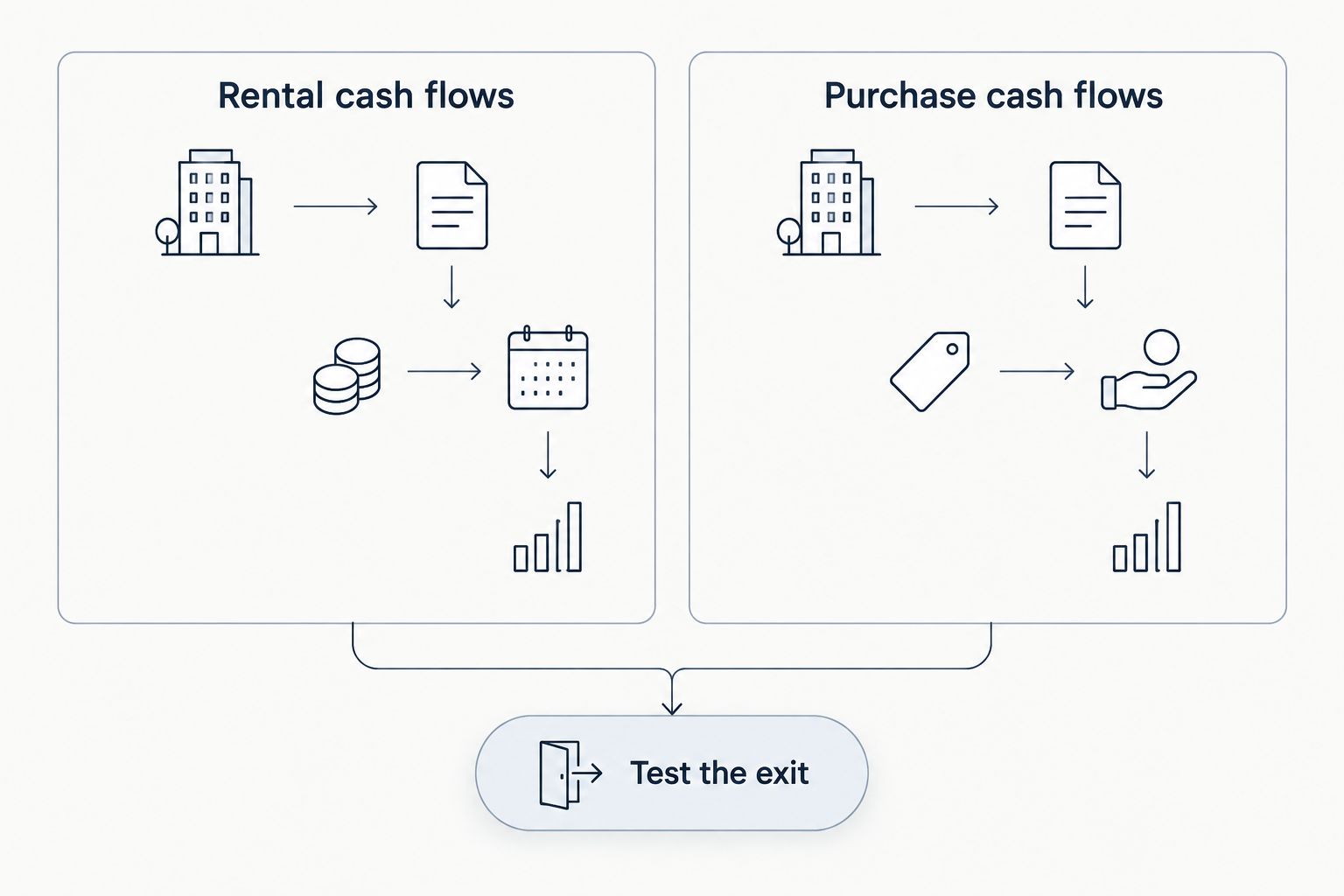
This is a cash-flow comparison and a risk comparison. A renter needs to know what the lease requires at departure. A buyer needs to know whether selling sooner than planned would change the result. Neither answer is visible in a mortgage-versus-rent headline.
Why renting or buying varies in the Netherlands
- Length of stay: Purchase and eventual selling costs matter more when spread across a shorter ownership period. An uncertain departure date makes a single break-even result unreliable.
- Location and home type: A rental and a purchase in different areas do not measure the same housing choice. Compare places you would actually live in.
- Financing: Your borrowing limit and mortgage terms affect what you can purchase and what you pay in interest. Use a lender's actual terms for a personal decision.
- Property condition: An owner pays for maintenance and repairs. A low proposed mortgage payment says nothing about a home's future repair needs.
- Lease terms: A renter's deposit, assigned charges and conditions for ending the tenancy affect both cash needed now and the cost of leaving.
- Sale outcome: Equity is not a guaranteed return. The amount you recover from a sale depends on the sale proceeds, outstanding debt and costs of selling.
Do not use a national average to decide between two specific addresses. In 2026, the result changes when you substitute your real lease, mortgage offer, property condition and expected departure date for generic figures.
Does a lower mortgage payment mean buying is cheaper than renting?
No. A mortgage payment excludes some purchase and ownership costs, while its principal portion reduces your loan balance. Compare the full cash flows over your expected stay, then look separately at the equity you would have when you leave.
Is renting better if you might leave the Netherlands soon?
Renting is usually the more flexible option when your departure date is uncertain. Check the lease's end conditions and compare them with the purchase and sale steps you would face as an owner. Flexibility does not make a particular rental affordable; it changes how much commitment you take on.
Can you buy a Dutch home without cash for purchase costs?
Do not assume so. The general mortgage cap of 100% of appraised market value does not mean the lender will cover every purchase expense or approve the full amount. Check financing and the cash required for your specific transaction before treating buying as an available alternative.
FAQ
Is renting cheaper than buying a home in the Netherlands in 2026?
Neither is cheaper for everyone in 2026. Compare matched homes over your expected stay, including up-front costs, ongoing payments and the cost of leaving.
Is buying cheaper if the mortgage payment is lower than the rent?
Not necessarily. A mortgage payment leaves out some ownership costs, and part of it repays principal rather than paying for housing.
What purchase tax should an owner-occupier consider in the Netherlands?
The general transfer tax rate for an eligible owner-occupied purchase is 2%, subject to applicable exemptions and conditions. Confirm the rate for your specific transaction before calculating costs.
Can a Dutch mortgage cover the full purchase price?
A Dutch mortgage is generally capped at 100% of appraised market value, with limited exceptions. Income assessment, valuation and purchase costs still affect how much cash you need.
Does paying rent build equity in a Dutch home?
No. Rent pays for occupancy; it does not reduce a home loan or give the tenant ownership of the property.
Is renting better for an expat who does not know how long they will stay?
Renting offers more flexibility when the length of your stay is uncertain. Check the lease terms, deposit and moving costs before choosing a specific home.
What should I compare besides rent and mortgage payments?
Compare move-in and purchase costs, recurring charges, maintenance, financing and the cost of leaving. Keep refundable deposits and mortgage principal separate from nonrecoverable expenses.
One last thing
The most useful question is not whether rent exceeds a mortgage payment this month. It is what each choice leaves you with when you move out: a rental deposit to settle under the lease, or a property to keep or sell with a loan still attached. In 2026, put your likely departure date into the comparison before you decide which monthly figure looks better.