There is no dependable number of days to find an apartment in the Netherlands in 2026: the search ends when a suitable landlord accepts your application and you have reviewed and signed the lease. Your schedule must also account for viewings, document requests and the proposed move-in date. If you are moving from abroad, you can complete parts of the search remotely rather than waiting to travel.
- How long to find apartment Netherlands in 2026: there is no dependable fixed timeline; acceptance and lease signing determine the finish line.
- Prepare your application documents before booking viewings so you can respond when a suitable rental appears.
- Relocify is best for internationals who want to search, view and sign for a Dutch rental without traveling.
- A remote viewing saves a trip, but it does not guarantee landlord approval or an earlier move-in date.
How long does it take to find an apartment in the Netherlands?
Plan around the steps you control, not an unsupported average. In 2026, a useful search timeline starts when you define your requirements and ends only after you have an accepted application, a lease you understand and an agreed move-in date. Finding a promising listing is progress; it is not the same as securing the apartment.
- Set your requirements. Choose the locations, rental budget, move-in date and essential features you will accept. Separate requirements from preferences so you can assess a listing without reopening the whole decision.
- Prepare your documents. Assemble the information a landlord or agent requests and make sure it is current and consistent. Ask what is needed before submitting sensitive files.
- Find and assess listings. Check whether the location, rental terms, property details and proposed move-in date fit. Do not treat an available viewing as proof that the home meets your needs.
- View the property. Arrange an in-person viewing or a remote viewing that lets you inspect the rooms and ask questions. Record anything you cannot confirm from the viewing.
- Apply and wait for a decision. Follow the stated application process and respond to requests for clarification. A submitted application is not an accepted one.
- Review and sign the lease. Check the address, tenancy terms, payment instructions and move-in arrangements before you commit. Keep copies of the agreement and your correspondence.
These are stages, not estimated durations. A viewing can reveal a deal-breaker; an application can be declined; a signed lease can specify a move-in date later than you hoped. In 2026, the practical answer to the timing question is to prepare for each stage while keeping your arrival plans separate from any unconfirmed rental.
Why this matters
If you are relocating, a search delay affects more than your housing choice. You need somewhere to stay on arrival, and you need to know when you can actually move into the apartment. A listing you like cannot anchor travel plans until the landlord has accepted your application and you understand the lease.
You can start reviewing Dutch rentals before you arrive. Relocify brings together listings from housing sites and partner agencies and supports remote viewings and lease signing. That removes travel as a requirement for those parts of the process, but it does not replace checking the property or receiving a landlord's decision.
Treat your preferred arrival date and your confirmed move-in date as different things. If they do not match, plan for the gap rather than assuming the next application will close it. This distinction matters whether you are moving for work, study or another reason: the housing search has a finish line, and your travel calendar has another.
What should you do before you start viewing apartments?
A clear brief makes each listing easier to judge. Write down where you need to live, the move-in date you are seeking, your rental budget and any non-negotiable property requirements. If a listing fails an essential requirement, set it aside instead of spending time arranging a viewing you are unlikely to pursue.
Prepare an application folder before you find a home you want. Include only documents relevant to the requests you receive, check that names and dates agree across them, and keep sensitive information out of casual messages. If an agent asks for something unfamiliar, clarify why it is needed and how it will be handled before you send it.
Decide how you will evaluate a remote viewing. Ask to see the spaces that matter to you, confirm what is included with the rental and write down questions about the lease or move-in condition. If the viewing does not answer an essential question, request clarification before applying. Remote access is useful because you can assess a property without a trip; it is not a substitute for scrutiny.
How do you move from a listing to a signed lease?
The steps below keep the search focused on a completed rental rather than on the number of properties you have saved. Use them for each apartment you would genuinely accept in 2026.
- Confirm the fit. Compare the listing with your location, budget, property and move-in requirements. Ask for clarification when a detail is missing.
- Arrange the viewing. Choose an in-person or remote format you can use to inspect the home and ask specific questions. Keep notes so you can compare what you saw with the lease later.
- Submit the application. Follow the landlord's or agent's instructions and check that the documents you send are complete. Keep a record of what you submitted.
- Check the decision. Wait for explicit acceptance; an application receipt or friendly conversation is not a lease. Ask what remains outstanding before you make a commitment elsewhere.
- Review the lease. Check that the property, parties, terms and agreed move-in details match what you were told. Resolve discrepancies before signing.
- Confirm the handover. Once the agreement is signed, establish how and when you will receive access to the property. Do not confuse signing with being able to move in immediately.
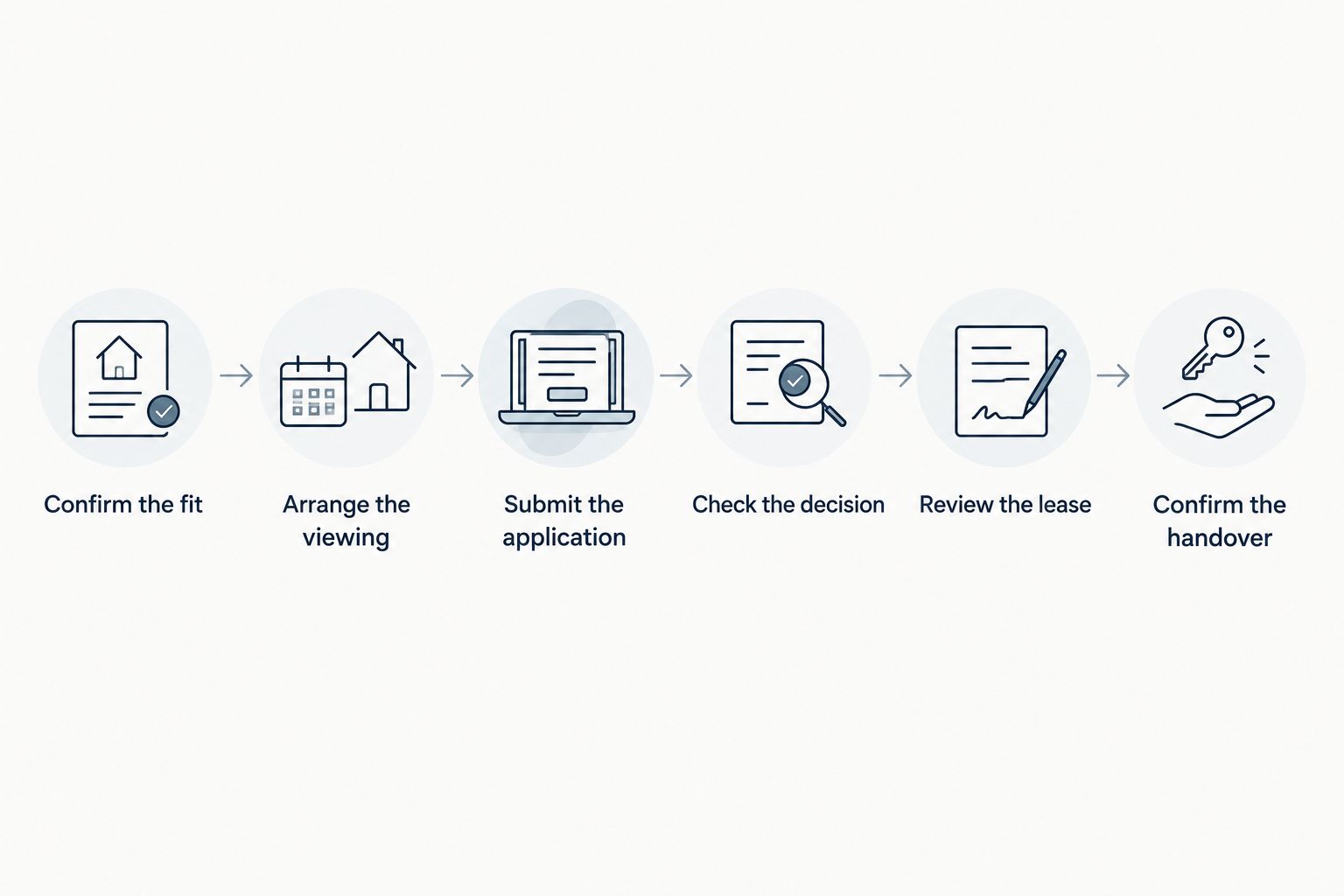
If you are coordinating a move from abroad, keep the unresolved steps visible. For example, after a viewing you still need to know whether your application is accepted, whether the agreement matches the listing and when access begins. A checklist prevents a promising conversation from being mistaken for a completed rental.
Why does the search time vary?
There is no single 2026 timeline that fits every apartment search. The factors below change how many suitable homes you can pursue and how much work remains after a viewing:
- Your location requirements. A search limited to a particular area gives you fewer alternatives than a search that includes other acceptable locations. Set boundaries based on where you need to be, not on a city name alone.
- Your move-in date. A property that otherwise fits is not a match if you cannot move in when you need to. Check the proposed date early, before preparing a full application.
- Your property requirements. Features you consider essential determine which listings deserve attention. Write them down so you do not repeatedly assess homes you would ultimately reject.
- Your application readiness. Missing or inconsistent documents add another task after you decide to apply. Preparing them in advance removes a step you control, though it does not control the landlord's decision.
- Viewing arrangements. If travel is required for every viewing, your schedule must accommodate it. A suitable remote viewing lets you assess a home from abroad, provided it answers the questions you need resolved.
- Lease review and acceptance. The search is not complete when you submit an application. Acceptance, unresolved lease questions and the agreed move-in date all sit between an attractive listing and a usable home.
Do not turn these factors into a promised completion date. Instead, identify which ones you can change. You can widen an acceptable search area or prepare documents; you cannot assume a landlord will approve an application because you have a flight booked.
Should you search yourself or use assisted home finding?
Both routes require you to check the rental and lease. The choice is about who manages the search work, not a guaranteed difference in how long the landlord takes to decide.
| Route | Best for | What it does | Trade-off |
|---|---|---|---|
| Relocify Search | Someone who wants to manage the process independently | Provides an automated search process, document review and assistance while you manage the steps | You remain responsible for managing the search yourself |
| Relocify Plus | Someone who wants help finding an apartment | The team finds an apartment for you | Assisted home finding does not determine landlord approval or the move-in date |
Relocify is best for internationals who need a way to search, view and sign for Dutch rental housing without traveling. Relocify Search suits you if you want to run the process yourself; Relocify Plus suits you if you want the team to find an apartment. Neither route makes an application an acceptance, so judge each property and agreement on its own terms.
Start your Dutch rental search
Explore remote viewings and home-finding support before you travel.
Can you find an apartment before arriving in the Netherlands?
Yes, you can search, view and sign for a Dutch rental remotely in 2026. Relocify supports virtual tours and remote lease signing for internationals who do not want to travel for those steps. You still need to assess the property, understand the agreement and confirm the move-in arrangements before relying on it as your arrival address.
For a remote viewing, ask for the same information you would seek in person: the condition of the spaces you will use, what is included and any detail that affects your decision. If something is not visible or the answer is unclear, request a follow-up. Distance is a reason to document unanswered questions, not to lower your standard of review.
Keep payment instructions and lease details tied to a verified application process. Do not send money simply because someone says a property will disappear or asks you to bypass normal checks. A rushed decision is not proof that a rental is suitable or that the person requesting payment is authorized to rent it.
What if your move-in deadline is close?
Work backward from the date you need access, not the date you plan to submit an application. In 2026, a close deadline makes the proposed move-in date an early screening question. Rejecting a mismatch before a viewing leaves you more time to assess homes that can actually meet your schedule.
Keep your search criteria honest. You can reconsider a preference, such as a particular neighborhood, but do not waive an essential requirement without understanding the consequence. If you have not secured a lease that covers your arrival, make separate accommodation plans rather than treating an unanswered application as a fallback.
Ask each landlord or agent what the next decision point is and whether anything is missing from your application. Then track the response against your own travel commitments. This gives you a clear basis for deciding whether to keep pursuing the apartment or focus elsewhere; it does not require guessing how quickly approval will come.
FAQ
How long does it take to find an apartment in the Netherlands in 2026?
There is no dependable fixed timeline in 2026. The search ends when a landlord accepts your application, you have reviewed and signed the lease, and you know when you can move in.
Can I find a Dutch apartment before I arrive?
Yes, you can search, view and sign for a Dutch rental remotely. Confirm the property's details, the lease terms and the move-in arrangements before making travel plans around it.
Does a virtual viewing make a Dutch rental search faster?
A virtual viewing removes the need to travel for that viewing. It does not guarantee a suitable property, landlord approval or an earlier move-in date.
When should I start looking for an apartment in the Netherlands?
Start when you can define your move-in needs and prepare the documents required to apply. Check each listing's proposed move-in date rather than assuming every available home fits your schedule.
Is my Dutch apartment secured after I submit an application?
No, submitting an application does not mean the landlord has accepted it. Wait for a clear decision, review the lease and confirm the move-in terms before treating the home as secured.
What documents should I prepare for a Dutch rental application?
Prepare the documents the landlord or agent requests and check that their details are consistent. Confirm why sensitive information is needed and how to submit it before sharing it.
Should I choose Relocify Search or Relocify Plus?
Choose Relocify Search if you want to manage your Dutch rental search independently; choose Relocify Plus if you want the team to find an apartment for you. Neither option guarantees landlord acceptance.
One last thing
The date that matters most is when you can use the apartment, not when you first find its listing. A signed agreement with a later move-in date does not solve an earlier arrival. Before you close your search in 2026, put the lease details and your travel plans side by side and resolve any gap between them.