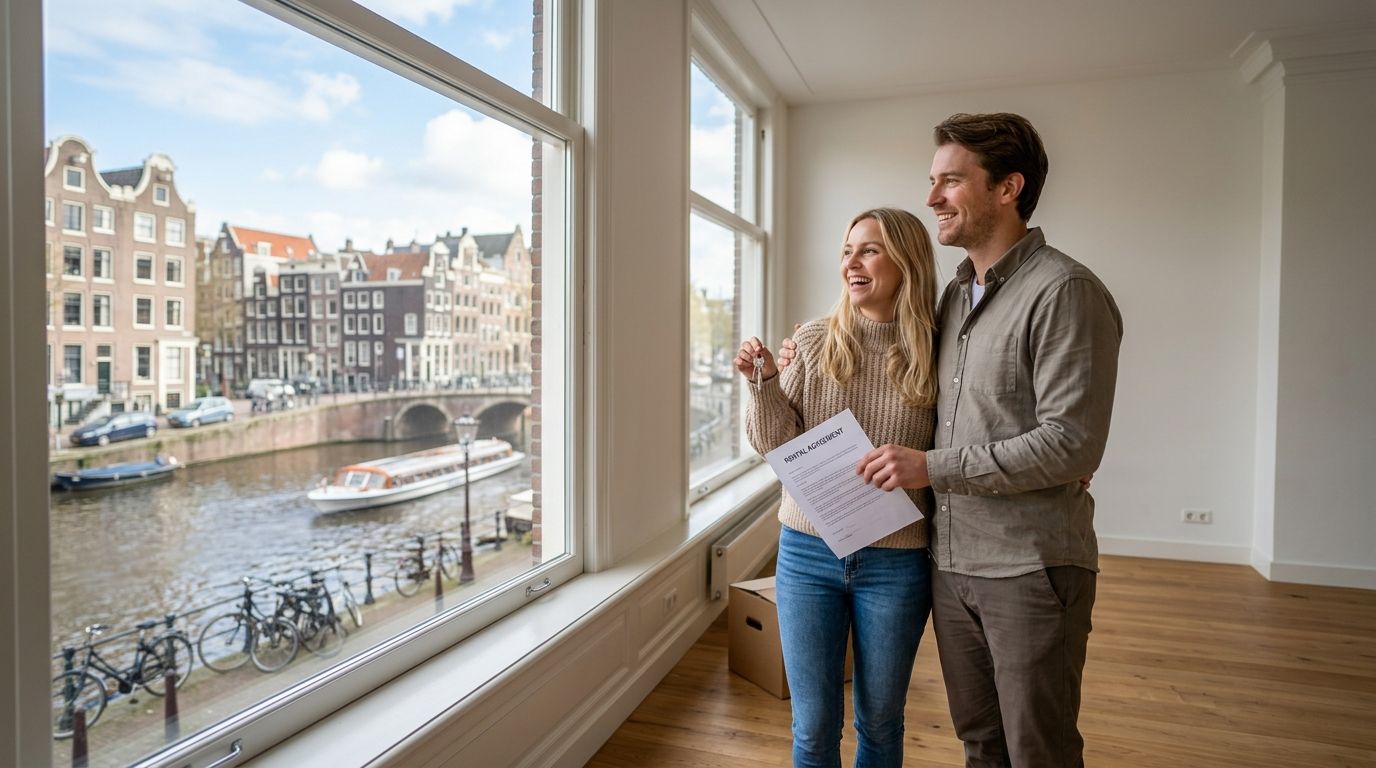
Expats searching for no-deposit apartments for rent in the Netherlands run into one hard truth fast: Dutch landlords almost always ask for a security deposit, typically one to two months' rent, before handing over the keys. True zero-deposit listings exist, but they are the exception, not a search filter you can rely on. What actually works for this segment is knowing which deposit alternatives are real, which guarantor and income-verification routes replace a cash deposit, and how to budget so a deposit requirement does not blow up your move.
This guide is built for expats and internationals without a Dutch bank history, a local guarantor, or Dutch payslips — the exact profile landlords reject when they default to "deposit plus proof of income" as their only vetting method. Relocify works with this segment through remote viewings and remote lease signing, so the steps below reflect what gets an application approved in 2026, not theory.
- True no-deposit apartments for rent in the Netherlands are rare; most landlords require one to two months' rent as a deposit.
- Guarantor services and employer-backed guarantees are the realistic substitute for expats without Dutch credit history.
- Income verification without Dutch payslips blocks more expat applications than the deposit itself.
- Relocify Search lets you self-manage documents with AI assistance; Relocify Plus assigns a team to find the apartment for you.
- Budget two months' rent as a contingency even while pursuing a deposit waiver.
Why this matters for expats
Expats hit a wall Dutch renters do not: no local bank account with transaction history, often no BSN yet, and no Dutch employer payslip on day one. A landlord holding firm on a two-month deposit is normal. A landlord who accepts no alternative income proof at all is the filter you actually need to plan around.
The practical outcome is simple. Chasing listings labeled "no deposit" burns weeks. Screening for landlords and agencies that accept a guarantor or a deposit-waiver product in place of cash gets you into a lease faster, even in the tight 2026 markets in Amsterdam, Utrecht, and The Hague.
Get real about what "no-deposit" means in the Dutch market
- Most private landlords set deposits at one to two months' rent, paid before or on move-in day
- Some build-to-rent operators and corporate housing providers waive the cash deposit in exchange for a signed employer guarantee
- Listings advertised as "no deposit" are frequently furnished short-stay units, not standard unfurnished long-term leases
- Certain agencies replace the deposit with a deposit-insurance product carrying a recurring fee instead of a lump sum
- None of these routes remove the landlord's right to charge for damage at move-out — they only change how it is secured
Line up a guarantor before you start applying
A guarantor is the single biggest lever expats have against a cash deposit requirement. Landlords accept one because it shifts financial risk to a company or employer instead of your Dutch bank balance.
- Ask your employer whether a housing guarantee is part of your relocation support
- Compare guarantor companies for renting in the Netherlands before you apply anywhere, not after a rejection
- Confirm whether the guarantor covers rent default only, or rent plus damage costs
- Weigh the guarantor's fee structure against tying up two months' rent in cash
- Get the commitment in writing before viewings so you can present it the moment you apply
Solve the income-verification problem without Dutch payslips
Dutch landlords ask for three Dutch payslips because it is the fastest way to verify you can pay. Expats without that paper trail get filtered out before a deposit conversation even starts. This is where most no-deposit searches actually die.
- Use income verification alternatives for expats — employment contracts, foreign payslips, and employer letters all substitute in practice
- Have your employment contract translated or notarized if the agency requests it
- Prepare bank statements showing consistent income, even from a foreign account
- On a highly skilled migrant visa, include your IND confirmation as proof of legal status and income
- Relocify Search handles document upload and AI-assisted review yourself, so a missing file does not stall an application for days
Get help landing a deposit-friendly lease
Relocify Plus assigns a specialist to search, negotiate, and handle your documents.
Budget for a full deposit even while chasing waivers
Plan your cash assuming you will pay a standard deposit, then treat any waiver as upside. This one shift stops expats from missing move-in deadlines while holding out for a listing that never appears.
- Set aside the equivalent of two months' rent as contingency, even on a guarantor route
- Factor currency conversion timing if your funds sit in a non-euro account
- Ask whether the deposit is refundable in full or subject to wear-and-tear deductions
- Confirm the accepted payment method — many Dutch landlords require a completed bank transfer days before key handover
- Add a buffer for first-month utilities on top of rent and deposit
Review every deposit clause before you sign
A waived deposit means nothing if the lease lets the landlord recover the same money through other fees. Read the contract line by line, especially deposit conditions and damage assessment.
- Confirm in writing which conditions trigger a full or partial deduction
- Check that the guarantor's liability period matches your lease term
- Verify the move-out inspection process is specified, not left vague
- Clarify notice periods so early termination does not cost you the deposit
- Signing remotely means the review happens before the signature, never after — see how to sign a Dutch lease without visiting the property
Protect your deposit return from day one
Expats who ignore deposit return until move-out day lose money to disputes that ten minutes of documentation at move-in would have prevented.
- Photograph every room, wall, and appliance at move-in with timestamps
- Store the signed day-one inspection report somewhere retrievable from abroad
- Log any landlord-approved repairs or changes during the tenancy
- Learn the deduction dispute process before your lease ends, not in the final week
Comparison: deposit alternatives for expats
| Option | Best for | Key limitation |
|---|---|---|
| Guarantor company | Expats with no Dutch credit history and no co-signing employer | Adds a recurring fee on top of rent |
| Employer-backed guarantee | Corporate relocations with HR-managed housing budgets | Only available if your employer offers it |
| Deposit insurance product | Renters avoiding a lump-sum cash outlay | Ongoing cost replaces a one-time refundable payment |
| Standard cash deposit | Renters with liquid savings and no guarantor access | Ties up one to two months' rent until move-out |
| Furnished short-stay unit | Arrivals needing a first 1-3 months while searching | Higher monthly rent, rarely a long-term solution |
Verdict: a guarantor company is the fastest realistic route to cutting your cash deposit as an expat in the Netherlands in 2026 — a genuinely no-deposit apartment is an exception you should never build a move around.
“Do not search for no-deposit listings. Search for landlords who accept a guarantor.”
How the two Relocify routes differ
Relocify Search is the self-managed path: you filter aggregated listings from housing sites and partner agencies, request virtual tours, run documents through AI review, and drive the application yourself. Relocify Plus is the assisted path: a team searches, shortlists, and handles landlord communication on your behalf.
Best for Relocify Search: internationals with time to run their own search and a straightforward income profile. Best for Relocify Plus: expats relocating on a fixed start date, or anyone whose income proof needs explaining to a skeptical landlord.
Common mistakes expats make
- Searching the phrase "no deposit" instead of screening for landlords who accept guarantors — the first returns short-stay units, the second returns real long-term leases
- Arranging a guarantor only after a rejection, losing days in a market where good units go in hours
- Assuming a foreign payslip is automatically accepted without confirming with the specific agency first
- Signing remotely without anyone reviewing the deposit-deduction clauses
- Underestimating international transfer time when a deposit must land in a Dutch account by a fixed date
- Treating the deposit as the whole cost — agency fees, first month's rent, and utilities setup land in the same week
FAQ
Are there truly no-deposit apartments for rent in the Netherlands?
True zero-deposit apartments exist but are uncommon; most Dutch landlords in 2026 require one to two months' rent as a security deposit. Furnished short-stay units and some corporate housing are the exceptions most likely to waive it.
Can a guarantor replace a cash deposit in the Netherlands?
Yes, many Dutch landlords accept a guarantor company or employer guarantee instead of a cash deposit, especially for expats without local credit history. The guarantor absorbs the financial risk if rent goes unpaid, which is why landlords treat it as a valid substitute.
Do I need Dutch payslips to rent an apartment as an expat?
No, landlords commonly accept foreign payslips, an employment contract, or an employer letter as income proof, though requirements vary by agency. Confirm the accepted documents with the specific landlord before applying so a rejection does not cost you the unit.
How much is a typical rental deposit in the Netherlands?
A typical Dutch rental deposit is one to two months' rent, paid before or at move-in. The exact figure depends on the landlord and whether the property is furnished or unfurnished.
Is it safe to sign a Dutch lease without visiting the apartment?
It is safe when the lease is reviewed clause by clause and the viewing came from a verified virtual tour rather than photos alone. Expats relocating from abroad sign this way routinely, but the deposit conditions should be checked before signature.
What happens to my deposit when I move out of a Dutch rental?
Your deposit is returned after a move-out inspection confirms no damage beyond normal wear and tear, minus any documented deductions. Timestamped photos taken at move-in are the strongest defense against disputed deductions.
Can Relocify help me find an apartment with a lower deposit?
Relocify Search lets you filter listings and manage guarantor and income documents yourself with AI assistance, while Relocify Plus assigns a specialist to search and negotiate for you. Neither invents deposit-free listings, but both speed up the guarantor and income-verification routes that actually reduce upfront cash.
Do international students face different deposit rules than working expats?
International students usually face the same one-to-two-month standard, though some student housing providers fold it into a service fee instead of a separate deposit line. Check the specific provider's terms rather than assuming a lower amount applies.
One last thing
The expats who land apartments fastest in 2026 are not the ones who found a mythical zero-deposit listing. They are the ones with a guarantor confirmed and income documents assembled before they apply, so they can commit to a unit within hours of it going live instead of days.