Relocating to the Netherlands for a new job means racing two clocks at once: your employer's start date and the Dutch rental market's brutal viewing-to-signing window. Here is the exact sequence that gets you from job offer to signed lease without a single flight.
- Relocating to the Netherlands for work in 2026 takes 4-8 weeks end to end if housing starts before you land.
- BSN registration and a signed lease are the two blockers that stall everything else — banking, insurance, payroll.
- Remote viewing and digital signing through a platform like Relocify Search cut the timeline by 2-3 weeks versus flying over to view in person.
- Skip cash-deposit listings and any landlord who won't do a scheduled virtual tour — both are 2026's most common rental scams in Amsterdam and Utrecht.
Why this matters
Dutch employers routinely give new hires 4 to 6 weeks between contract signing and start date, and that window is not enough time to fly over, view ten apartments, lose eight of them to faster applicants, and still handle a visa or 30% ruling application. The rental market in Amsterdam, Utrecht, and The Hague moves in days — listings viewed on a Monday are often gone by Wednesday. Relocating to the Netherlands for work in 2026 without a remote-viewing plan means you either delay your start date or arrive with nowhere to live.
What you'll need
- Signed job offer or employment contract with start date
- Passport and, if applicable, visa or residence permit application confirmation from your employer
- Proof of income (contract salary line, or 3 months of payslips if you're already employed by a Dutch entity)
- A Dutch phone number or plan to get one in your first week (many landlords and DigiD steps expect it)
- Budget set as gross monthly rent, not including utilities — most Dutch listings quote rent excluding gas, water, electricity
- Access to a remote rental platform such as Relocify for virtual tours and digital lease signing
The steps
1. Lock your job offer and sponsorship status
Confirm in writing whether your employer is handling your residence permit (IND) application or the 30% ruling, and get the expected approval timeline. This determines your legal start date in the Netherlands, not just your first day of work. Common mistake: assuming the 30% ruling is automatic — it requires a joint application by you and your employer, and processing can run 8-12 weeks in 2026.
2. Set a real housing budget before you browse
Calculate 30-35% of your gross monthly salary as a starting rent ceiling, then add roughly 150-250 euros a month for utilities and municipal taxes depending on city and household size. Landlords in the Netherlands generally require net income to be 3.5 to 4 times the monthly rent, so a 1,600 euro apartment usually needs a verifiable income above roughly 5,600 to 6,400 euros gross per month household-wide. Expected outcome: a budget range, not a single number, since income requirements vary by agency.
3. Start remote viewings 4-6 weeks before you land
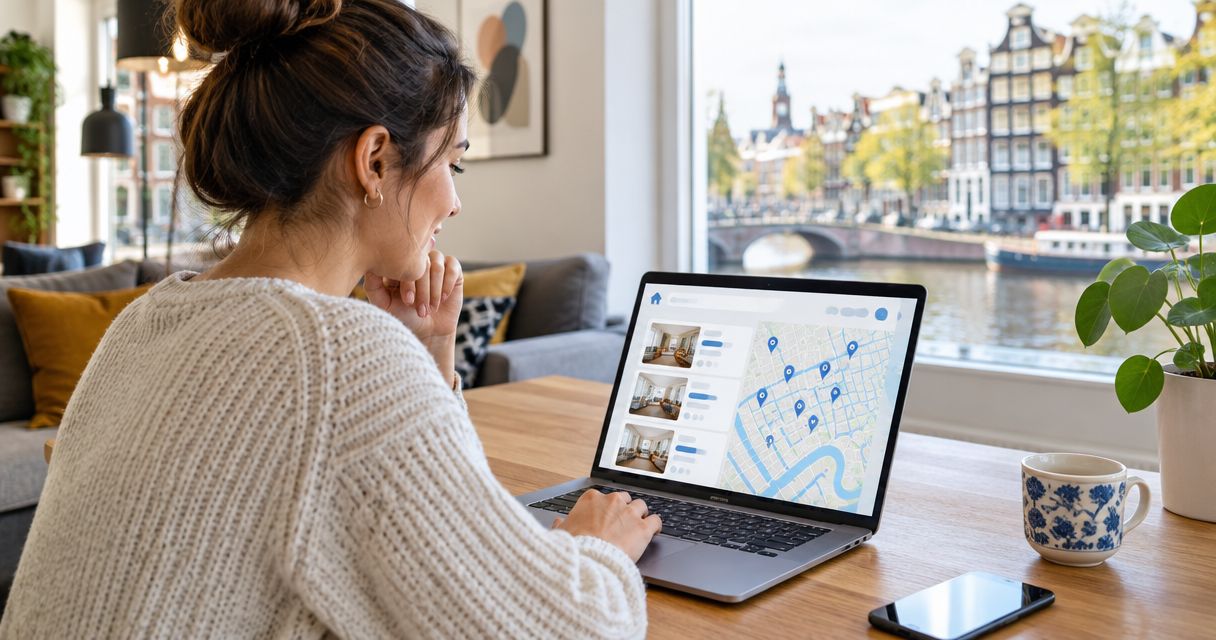
Book virtual tours the same week listings go live — in 2026, competitive listings in Amsterdam and Utrecht get 20-plus applicants within 48 hours. A platform aggregating listings across housing sites and partner agencies, like Relocify Search, lets you filter by move-in date and request a live virtual walkthrough instead of waiting for a flight. Common mistake: only viewing photos and skipping the live tour — photos hide noise, mold, and staircase width that matter for furniture moves.
4. Assemble your document folder before you apply
Landlords expect a complete packet on first contact: passport copy, employment contract, three recent payslips or an employer income letter, and a short personal introduction. Applicants who send a full folder on the first message get scheduled for viewings faster than those who trickle documents in over days. Common mistake: waiting for the landlord to ask for each document one at a time — by then the unit is already under offer.
5. Sign the lease digitally, then request the pre-departure checklist
Once approved, Dutch leases can be signed remotely through e-signature tools most agencies and platforms now support as standard in 2026 — you do not need to be physically present to sign. Ask for the move-in inspection report template and the meter readings process before you arrive, since disputes over initial condition are the most common post-move-in headache. Expected outcome: a signed contract and a key handover date, both confirmed before you book flights.
6. Register with your municipality (gemeente) within 5 days
Dutch law requires registering your address at the local gemeente within 5 days of arrival if you're staying longer than 4 months — this triggers your BSN (citizen service number), the single most important number for everything that follows: payroll, health insurance, banking, DigiD. Book the gemeente appointment online before you land, since walk-in slots in Amsterdam and Rotterdam routinely book out 2-3 weeks ahead in 2026. Common mistake: registering late and discovering payroll can't process your first salary without a BSN.
7. Open a Dutch bank account and sign up for health insurance
Most Dutch banks require a BSN to open an account, and your employer will need that account for salary payment — so this step depends entirely on step 6 landing on time. Health insurance is legally mandatory within 4 months of arrival or registration, and basic coverage runs roughly 120-150 euros a month per adult in 2026. Common mistake: assuming your home-country insurance covers you — Dutch basisverzekering is a separate legal requirement, not optional supplemental coverage.
8. Confirm utilities, internet, and municipal tax registration
Transfer or set up gas, water, and electricity accounts the week you get keys, and register for municipal waste tax (afvalstoffenheffing) if it's not bundled into your rent. Expected outcome: utilities active on move-in day, not a week later, which matters most in winter months when heating delays are genuinely uncomfortable.
Start viewing Dutch rentals remotely
Browse listings, book virtual tours, and sign digitally before you land.
Troubleshooting
- No BSN yet and payroll needs a bank account — ask HR for a temporary payroll workaround; some Dutch employers can hold your first salary in escrow for up to a few weeks while registration completes.
- Landlord rejects your foreign income proof — provide an employer letter stating gross annual salary in euros plus your signed contract; this satisfies most agencies that reject foreign payslip formats.
- No Dutch guarantor and the landlord insists on one — international-focused rental services and platforms built for expats, including Relocify, work with landlords who accept income-based approval instead of a local guarantor requirement.
- Every viewing slot is booked by the time you respond — set up real-time push notifications for new listings matching your filters; the fastest applicants respond within the first hour of a listing going live.
- The lease is only in Dutch — request an English summary or translation before signing; reputable agencies provide one on request, and this is a reasonable ask even under time pressure.
- A landlord asks for a cash deposit before any viewing — treat this as a hard stop. Legitimate Dutch landlords in 2026 do not collect deposits before a viewing or contract signature.
Tools and resources
- Relocify — aggregated Dutch rental listings, virtual tours, and digital lease signing for expats and internationals
- IND (Immigratie- en Naturalisatiedienst) — residence permit and visa status tracking
- DigiD — the digital ID you'll need for gemeente, tax, and insurance portals once you have a BSN
- Your gemeente's online appointment system — book this before booking flights
- Employer HR or relocation contact — the fastest source for 30% ruling and payroll timing questions
What to do next
If housing is the piece you haven't locked down yet, start with remote viewings now rather than after you land — Relocify's remote-first process, including the fully assisted Relocify Plus option, is built specifically for this timeline crunch, matching listings to your budget and move-in date while your visa and BSN paperwork run in parallel.
FAQ
How long does relocating to the Netherlands for work take in 2026?
Most work relocations to the Netherlands take 4 to 8 weeks from signed job offer to move-in, assuming housing search starts immediately alongside visa processing. The BSN registration and lease signing are usually the two steps that set the pace for everything else.
Can I sign a Dutch rental lease before I arrive?
Yes, most Dutch agencies and platforms in 2026 support remote e-signature for lease agreements, so you can sign before booking a flight. Confirm the key handover date and move-in inspection process in the same conversation as the signature.
Do I need a BSN before I can rent an apartment?
No, you can sign a lease before receiving a BSN, but you'll need the BSN afterward for payroll, banking, and health insurance. Register with your municipality within 5 days of arrival to get the BSN process started.
What income do landlords require for rentals in the Netherlands?
Dutch landlords typically require net income at 3.5 to 4 times the monthly rent. A landlord letter stating gross annual salary usually satisfies this requirement even without local payslips.
Is it possible to find Dutch rentals without visiting in person?
Yes, remote viewing through virtual tours has become standard for internationals relocating to the Netherlands for work in 2026, and platforms like Relocify let you filter, tour, and apply entirely online.
How much does health insurance cost when relocating to the Netherlands?
Basic Dutch health insurance (basisverzekering) runs roughly 120 to 150 euros a month per adult in 2026. It's legally required within 4 months of arrival or municipal registration.
What's the biggest mistake people make relocating to the Netherlands for a job?
Waiting to start housing search until after arrival is the most common and costly mistake. Competitive listings in cities like Amsterdam and Utrecht are gone within days, so remote viewing needs to start 4 to 6 weeks before the move.
Do I need a Dutch guarantor to rent as an expat?
Not always — many landlords and rental platforms accept income-based approval instead of a local guarantor for internationals with a verified job offer. Ask upfront, since guarantor requirements vary by agency and city.
One last thing
The detail most new hires miss: the gemeente appointment to get your BSN, not the flight or the lease, is usually the actual bottleneck in 2026, because slots in Amsterdam and Rotterdam book out 2-3 weeks ahead — book it the day your lease is signed, not the day you land.