The Hague splits its co-living market into five clear formats, and mismatching one to a work-from-anywhere schedule costs weeks of notice period or a commute that eats a whole morning. This guide ranks the best co-living spaces for digital nomads in the Hague for 2026, sorted by lease flexibility, built-in community, and how fast you can actually move in.
- Branded co-living residences are the best co-living spaces for digital nomads in the Hague overall in 2026: furnished, staffed, and flexible on lease length.
- Serviced apartments with co-working space fit stays under three months; shared apartments with private landlords cost less but take longer to arrange.
- Studio co-living hybrids near Beatrixkwartier suit remote workers who want a private desk and a short ride to Central Station.
- Student-housing-style co-living gets you keys fastest when your move-in deadline is under two weeks.
Why this matters
The Hague runs on international staff. The OPCW, the International Criminal Court, Europol, and dozens of embassies keep a steady flow of contractors, researchers, and remote employees moving through the city, and most of them need furnished housing for a few months, not a two-year Dutch rental contract. Standard Dutch leases assume you're staying put; co-living formats assume you might not be.
That gap is exactly where digital nomads get stuck. A rental platform built for internationals can shortcut the search, but you still have to know which co-living format actually matches your stay length before you start filtering listings. Pick the wrong one and you're either overpaying for flexibility you don't need or locked into a lease you can't break when the assignment ends early.
What makes the best co-living space in the Hague
- Furnished and move-in ready — down to kitchenware and a Wi-Fi router, no separate furniture order
- Lease flexibility — month-to-month or short blocks instead of a standard Dutch fixed-term contract
- Internet reliable enough for video calls — not an afterthought amenity
- Built-in community — shared kitchens, co-working corners, or resident events, not just a bed in a building
- Proximity to the international zone — the World Forum area, Central Station, and the tram lines that connect them
- Clear notice-period terms — spelled out before you sign, not discovered when you try to leave
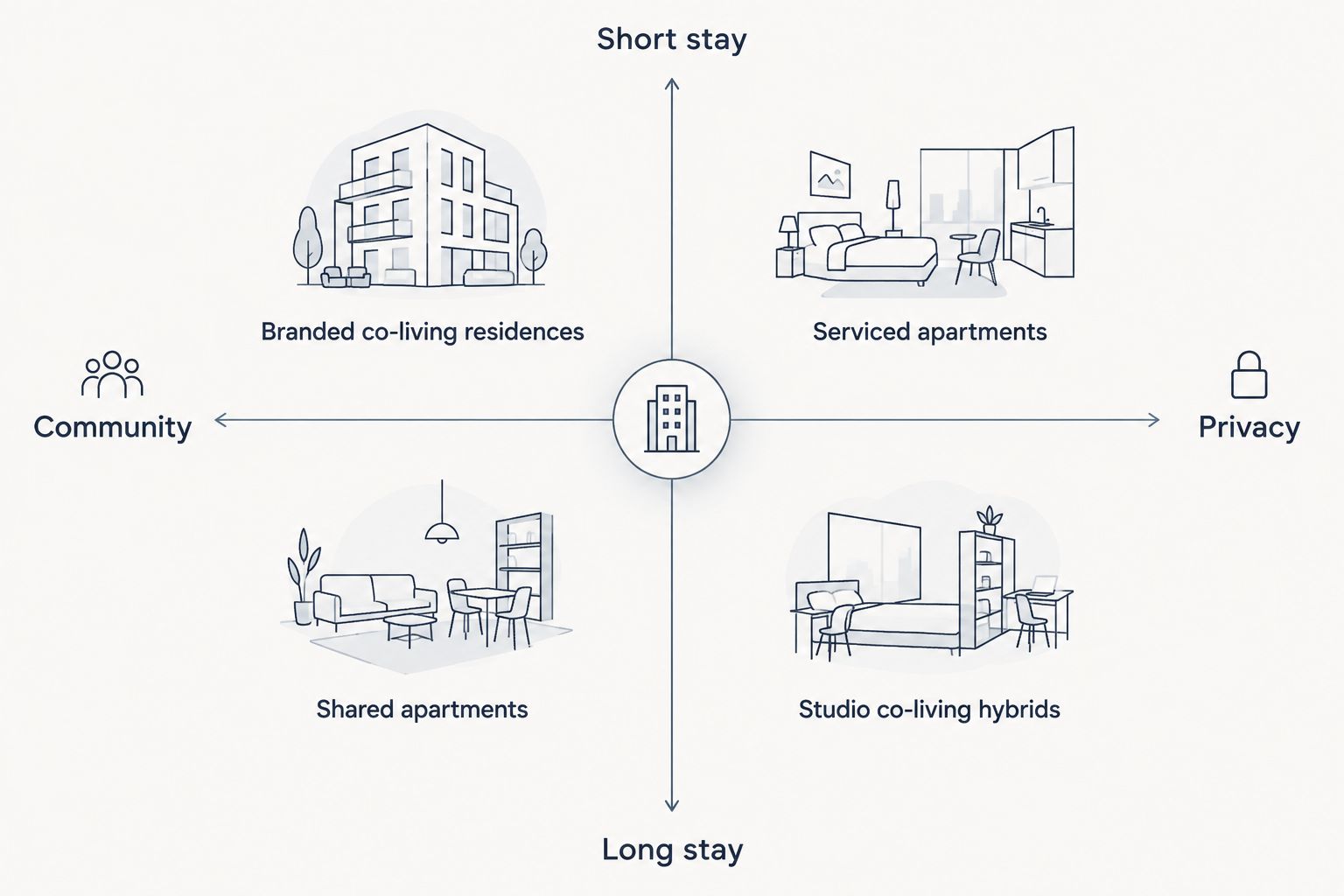
The Hague co-living options at a glance
| Option | Best for | Standout feature | Key limitation |
|---|---|---|---|
| Branded co-living residences | Community and turnkey furnished living | Onsite staff running shared common areas | Fewer available units than a standalone apartment search |
| Serviced apartments with co-working space | Stays under three months | A co-working desk built into the building | Runs pricier than a shared room |
| Shared apartments with private landlords | Budget-conscious digital nomads | Lower monthly cost, more room choices | Slower to arrange, guarantor and income checks apply |
| Studio co-living hybrids near Beatrixkwartier | Long-term remote workers wanting privacy | Private studio plus shared amenities | Longest waitlists of the five |
| Student-housing-style co-living for professionals | Fast move-in on a tight deadline | Fastest turnaround from application to keys | Smaller units, mixed-age community |
1. Branded co-living residences: best co-living for community and turnkey furnished living
These are purpose-built buildings run by an operator, not a private landlord: shared lounges, a communal kitchen or two, and staff who handle maintenance and check-in. Rooms come furnished and the lease usually runs in flexible blocks rather than a fixed Dutch year-long term.
Branded co-living residences pros:
- Fastest social integration for someone who just landed and knows nobody
- No separate furniture, utilities, or Wi-Fi setup to arrange
- Staff on hand for maintenance issues instead of chasing a private landlord
Branded co-living residences cons:
- Unit availability is tighter than the open rental market
- Common areas mean less control over noise and shared-space etiquette
Best for: newly arrived digital nomads who want a built-in network from day one. Verdict: Buy.
2. Serviced apartments with co-working space: best co-living for stays under three months
These buildings pair a private studio or one-bedroom with an in-house co-working area, so you're not working from your bed. Booking runs closer to a hotel stay than a Dutch tenancy, which is exactly why short-stay nomads use them.
Serviced apartments pros:
- Private unit with hotel-style flexibility on length of stay
- On-site work desk removes the need to find a separate coworking membership
- Housekeeping and utilities usually bundled into the arrangement
Serviced apartments cons:
- Less community feel than a co-living residence with shared kitchens
- Costs more per month than a shared apartment
Best for: contractors and consultants on a defined project timeline. Verdict: Buy if your stay is under three months.
“A co-living lease that lets you leave with 30 days' notice beats a two-year Dutch rental contract every time you're not sure how long you're staying.”
3. Shared apartments with private landlords: best co-living for budget-conscious digital nomads
This is the classic Dutch shared-house setup: a private landlord rents individual rooms in a house or apartment, and you split the kitchen and living room with roommates who may or may not be other internationals. It costs less than a branded residence but takes more legwork to secure.
Shared apartments pros:
- Lowest monthly cost of the five options
- Widest selection of rooms and neighborhoods to choose from
- Often more space per room than a purpose-built co-living unit
Shared apartments cons:
- Landlords in the Netherlands frequently require a guarantor or proof of income
- No built-in community events; you're relying on whoever else lives there
- Slower to close than a branded residence booking
Best for: nomads planning a stay of six months or longer who want to keep costs down. Verdict: Buy, but start the search early — guarantor and income checks add time.
4. Studio co-living hybrids near Beatrixkwartier: best co-living for long-term remote workers wanting privacy
These buildings blend a private studio apartment with shared amenities like a gym, a lounge, or a rooftop terrace, concentrated around Beatrixkwartier and the areas feeding into Central Station. You get your own door but still bump into other residents in the shared spaces.
Studio hybrids pros:
- Full privacy of a studio with occasional community access
- Short commute to Central Station and the international organization district
- Better sound insulation than a shared house, since you're not sharing walls with roommates
Studio hybrids cons:
- Longest waitlists of any option on this list
- Rarely available for stays under three months
Best for: remote employees on a 2026 assignment running six months or more who still want their own space. Verdict: Wait if you need keys inside two weeks; otherwise Buy.
5. Student-housing-style co-living for professionals: best co-living for a tight move-in deadline
Some buildings originally built for students now rent to young professionals and digital nomads, offering the fastest application-to-keys turnaround of any format on this list. Rooms run smaller and the community skews younger and more mixed than a branded residence.
Student-style co-living pros:
- Fastest move-in of the five options, often within days of applying
- Lower cost than a serviced apartment
- Shared laundry and kitchen facilities already built in
Student-style co-living cons:
- Smaller unit sizes than the other four formats
- Community mix skews younger, which may not suit every remote worker
Best for: anyone with a hard move-in deadline and no time to wait on a guarantor check. Verdict: Buy for speed, Skip if you need long-term privacy.
How we ranked these
Each option is scored against the six criteria above: furnished readiness, lease flexibility, internet reliability, built-in community, proximity to the international zone, and clear notice terms. The comparison table lists the same order as the sections, so the standout feature and the limitation for each format sit side by side with no scrolling required.
Which co-living space should you choose?
If you're arriving in the Hague in 2026 with no fixed end date and want people around you from the first week, branded co-living residences win by default. If your assignment runs under three months, book a serviced apartment with co-working space instead — the private desk pays for itself in focus time.
Budget-first nomads planning six-plus months should start a shared-apartment search early, since guarantor and income checks add lead time that the other four formats skip. Anyone against a hard move-in wall should default to student-style co-living and upgrade to a studio hybrid once the schedule settles down.
See how remote leasing works
View and sign for a Hague co-living unit before you land.
FAQ
What's the best co-living space for digital nomads in the Hague?
Branded co-living residences rank best overall for 2026 because they combine furnished units, flexible lease blocks, and built-in community without a long Dutch rental contract. Serviced apartments with co-working space beat them for stays under three months.
Is co-living cheaper than renting a studio apartment in the Hague?
Shared apartments with private landlords cost less per month than any co-living format on this list. Branded residences and serviced apartments trade that lower cost for furnishing, flexibility, and community.
How long can you stay in a co-living space in the Hague?
Most branded co-living residences and serviced apartments book in flexible blocks starting around one month, while shared apartments and studio hybrids lean toward longer stays of six months or more. Confirm the minimum term before applying since it varies by building.
Do co-living spaces in the Hague include high-speed internet?
Reliable internet suited for video calls is one of the six criteria used to rank the options above, and branded residences and serviced apartments typically build it in as standard. Always confirm the connection speed before signing if your work depends on video calls.
What's the difference between co-living and a serviced apartment in the Hague?
Co-living residences emphasize shared common areas and community events around a furnished room, while serviced apartments give you a private unit with hotel-style flexibility and less resident interaction. Pick co-living for community, serviced apartments for a private, short-term base.
Do shared apartments in the Hague require a guarantor?
Many private landlords renting shared apartments in the Netherlands ask for a guarantor or proof of income before signing. This is the main reason shared apartments take longer to secure than branded co-living residences.
Which Hague neighborhood is best for co-living near international organizations?
Areas around Beatrixkwartier and the World Forum district sit closest to the OPCW, the International Criminal Court, and the embassy cluster, with a short tram ride to Central Station. Studio co-living hybrids concentrate in exactly this area.
Can you move into a co-living space in the Hague on short notice?
Student-housing-style co-living for professionals offers the fastest turnaround, sometimes within days of applying. Studio hybrids and shared apartments with guarantor checks take the longest to close.
One last thing
Read the notice-period clause before the amenities list. Most co-living contracts in the Hague default to a minimum sit of one full month even when the marketing pitches month-to-month flexibility, and that single line matters more than the coworking desk or the rooftop terrace once your assignment changes shape.