Best overall for cycling commuters: Utrecht. Best for students and short commutes: Groningen. Best for tech campus commuters: Eindhoven. Best for combining biking with train travel: Zwolle. Best for international professionals near business districts: Amsterdam. Each city solves a different commuting problem, and picking the wrong one in 2026 means fighting bus schedules or paying rent for a location that doesn't match how you actually get to work.
- Utrecht is the best city in the Netherlands for cycling commuters who want a door-to-door bike route in 2026.
- Groningen has one of the highest bicycle mode shares in the country, best for students and tight budgets.
- Eindhoven's Hovenring links residential neighborhoods to the High Tech Campus for tech workers commuting by bike.
- Zwolle suits commuters who bike locally and take the train to jobs in nearby cities.
- Amsterdam has the densest cycle network into business districts but carries rush-hour bike congestion.
Why this matters
Where you rent in the Netherlands decides whether your commute is a 15-minute ride through a park or a daily transfer between two buses. Dutch cities were built around the bicycle over decades, but the quality of that infrastructure varies sharply: Utrecht's segregated lanes are not the same experience as a suburb with painted-only bike lanes and no dedicated crossings.
Renting sight-unseen from abroad through Relocify means checking the cycling network around a listing before you sign, not after you've moved in. A flat commute matters more day-to-day than a slightly bigger apartment three bus stops from the nearest bike path.
What makes the best city for cycling commuters
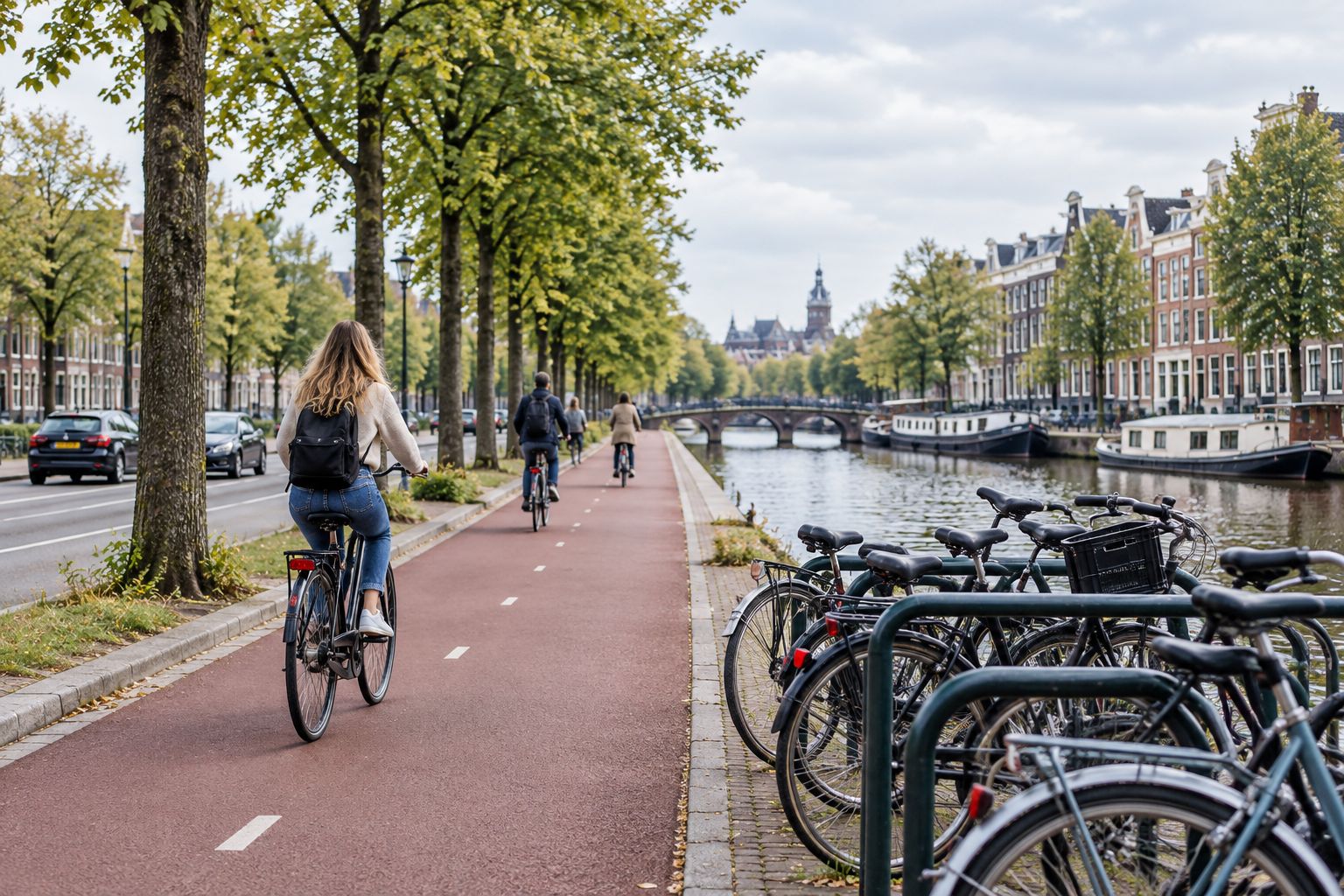
- Segregated bike lanes physically separated from car traffic, not just painted lines
- Flat terrain and short average trip distances across the city
- High-capacity, secured bike parking at train stations and city centers
- Bike-to-train integration for commuters whose employer is in a different city
- Compact layout keeping groceries, work, and transit within a short ride
- Low reported bike theft relative to the size of the city
Best cities for cycling commuters in the Netherlands: at a glance
| City | Best for | Standout feature | Key limitation |
|---|---|---|---|
| Utrecht | Door-to-door bike commuting | World's largest bike parking garage at Centraal station | Popular routes get congested during rush hour |
| Groningen | Students and short commutes | One of the highest shares of daily trips made by bike in the country | Smaller job market outside education and research |
| Eindhoven | Tech campus commuters | Hovenring floating bike roundabout links suburbs to the High Tech Campus | Longer average distances between neighborhoods and employers |
| Zwolle | Bike-and-train commuters | Entire historic core reachable by bike within minutes | Fewer international job openings than the Randstad cities |
| Amsterdam | International professionals near business districts | Dense cycle network reaching most business districts | Heavy bike traffic on main routes during peak hours |
1. Utrecht: best for door-to-door bike commuting
Utrecht is flat, compact, and built around a cycling network that connects nearly every neighborhood to the center without a car being necessary. Utrecht Centraal station holds more than 12,500 covered bike parking spaces, the largest facility of its kind anywhere, which makes bike-plus-train commuting to Amsterdam or Rotterdam straightforward.
Utrecht pros:
- Extensive segregated lanes separated from car lanes on nearly every main route
- Flat terrain with minimal elevation to slow down a daily ride
- 12,500+ secure bike parking spaces at Centraal for onward rail travel
- Central location inside the Randstad shortens onward commutes to other cities
Utrecht cons:
- Rents near the city center run above the national average
- Main cycling corridors get crowded during the 8am and 5pm rush
- Apartments near bike-friendly neighborhoods fill quickly
Check bike-friendly apartments for rent in Utrecht for listings near the main cycling corridors. Verdict: choose Utrecht if you want the most complete cycling network in the country and don't mind rush-hour traffic on the busiest routes.
2. Groningen: best for students and short commutes
Groningen is a university city where daily life is organized around the bike rather than the car. The city center is closed to most through car traffic, and average commute distances are short enough that a 10-minute ride covers most of what a resident needs.
Groningen pros:
- One of the highest shares of daily trips made by bike in the Netherlands
- Short average commute distances across the entire city
- Rents typically lower than Randstad cities like Amsterdam or Utrecht
Groningen cons:
- Job market outside education, research, and healthcare is thinner
- Fewer direct international flight connections nearby than Amsterdam or Eindhoven
- Winter cycling means more wind exposure on the open northern routes
For researchers and postdocs relocating specifically for university or hospital positions, see apartments for rent in Groningen for postdoctoral researchers. Verdict: choose Groningen if your work is tied to the university or research sector and you want the shortest commute in the country.
3. Eindhoven: best for tech campus commuters
Eindhoven built its cycling infrastructure around getting people to work, not just around the historic center. The Hovenring, a floating bicycle roundabout, links residential neighborhoods on the north side of the city to the High Tech Campus without crossing a single car lane.
Eindhoven pros:
- Dedicated cycling corridors connecting neighborhoods directly to major employers
- Growing international workforce with English widely used at tech employers
- Flat terrain comparable to Utrecht and Groningen
Eindhoven cons:
- The city is more spread out, so some neighborhoods sit farther from the campus than Utrecht or Groningen residents ride to work
- Public transit is less dense than in the Randstad, so biking is closer to mandatory than optional
For listings near the campus itself, see apartments for rent near Eindhoven High Tech Campus. Verdict: choose Eindhoven if your job is on or near the High Tech Campus and you want a bike commute that skips car traffic entirely.
4. Zwolle: best for combining biking and train commuting
Zwolle is smaller than the four cities above it in most rankings, but its position as a rail hub makes it a strong pick for anyone who bikes locally and takes the train for work in a different city. The compact historic core is reachable by bike within minutes from most residential streets.
Zwolle pros:
- Entire city center reachable by bike in under 15 minutes from most neighborhoods
- Strong rail connections for hybrid bike-and-train commutes to Amsterdam, Utrecht, or Groningen
- Rents generally lower than the Randstad
Zwolle cons:
- Fewer large international employers based directly in the city
- Job market more limited than Amsterdam, Utrecht, or Eindhoven for non-Dutch speakers
Verdict: choose Zwolle if you plan to bike locally and commute by train, and want lower rent without giving up cycling infrastructure.
5. Amsterdam: best for international professionals near business districts
Amsterdam has the densest bike network of any Dutch city, reaching almost every business district including the Zuidas financial and legal hub. The tradeoff is volume: more cyclists, more tourists on bikes, and more congestion on the main bridges and canal-side routes during peak hours.
Amsterdam pros:
- Cycling network reaches nearly every business district and neighborhood
- Largest concentration of international employers and English-speaking workplaces
- Bike-share and public transit integration for days you don't want to ride
Amsterdam cons:
- Heavy bike traffic on main routes and bridges during rush hour
- Rents run higher than any other city on this list
- Bike theft is more common than in smaller Dutch cities
For listings near the financial district, see apartments for rent near Amsterdam Zuidas. Verdict: choose Amsterdam if your job is in a central business district and the cycling network matters more to you than avoiding congestion.
How this list was ranked
Each city was measured against the criteria above: segregated lane coverage, terrain, station bike parking capacity, bike-to-train integration, and how compact the city is day to day. No city wins on every criterion, which is why the list is a decision tree by commute type instead of a single leaderboard.
“The best cycling city for you is the one where your actual commute route has a curb between you and car traffic, not the one with the best national reputation.”
Which city should you choose?
If you're still undecided, Utrecht is the default pick for 2026: it has the most complete cycling network, the largest bike parking facility in the country, and a central location that shortens onward travel if your job search isn't finished yet. Choose Groningen if you're heading into research or academia, Eindhoven if your employer is on the High Tech Campus, Zwolle if you want a bike-and-train hybrid commute, and Amsterdam if your work is fixed to a central business district and you can live with rush-hour bike traffic.
Find a rental near your bike route
Search live Dutch listings and view apartments remotely before you sign.
FAQ
What is the best city in the Netherlands for cycling commuters in 2026?
Utrecht is the best overall pick in 2026 because of its segregated lane network and the 12,500-plus space bike parking garage at Centraal station. Groningen, Eindhoven, Zwolle, and Amsterdam each fit a different commute pattern better depending on your job and budget.
Is Utrecht or Amsterdam better for biking to work?
Utrecht has less bike traffic and a more complete segregated lane network, making the daily ride smoother. Amsterdam has more business districts within biking distance but heavier congestion on main routes during rush hour.
How far can you realistically commute by bike in a Dutch city?
Most daily commutes in compact Dutch cities like Utrecht, Groningen, and Zwolle stay under 20 minutes by bike because the cities are built at a scale that keeps work, home, and transit close together. Longer distances are usually covered by combining a bike with a train.
Which Dutch city has the best bike parking at its train station?
Utrecht Centraal has the largest bicycle parking facility in the world, with more than 12,500 covered spaces, making it the strongest option for commuters who bike to the station and take a train onward.
Do Dutch cities combine biking with train commuting well?
Yes, most Dutch cities are designed around a bike-to-train model, with secure parking at nearly every station. Zwolle and Utrecht are particularly strong for this because of their rail hub positions.
Is Groningen good for international workers outside academia?
Groningen's job market leans heavily toward education, research, and healthcare, so professionals outside those fields often find more openings in Amsterdam, Utrecht, or Eindhoven. It remains one of the best cities for short, all-bike commutes.
What should international renters look for in a bike-friendly Dutch apartment?
Check whether the route to work uses segregated bike lanes rather than painted-only lanes, and whether the building has secure indoor or covered bike storage. Proximity to a train station matters if the job is in a different city.
How safe is cycling in Dutch cities compared to other European cities?
Dutch cities are widely recognized for prioritizing segregated cycling infrastructure over shared car lanes, which is the main design difference from most other European cities. Bike theft risk still varies by city, with larger cities like Amsterdam reporting more incidents than smaller ones like Zwolle.
One last thing
Houten, a small town near Utrecht, didn't make the ranked list because it's not a major job center, but it's the clearest example of what Dutch cycling planning looks like when built from scratch: car traffic is routed around the outside of town on a ring road, while a continuous internal bike network lets residents reach the center, schools, and the train station without ever crossing a car lane. It's worth a look if you work in Utrecht but want a quieter, fully bike-first residential town nearby.